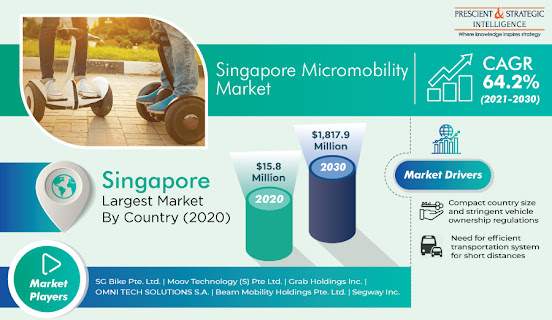
The Singapore micromobility market will advance at a 64.2% compound annual growth rate, to reach USD 1,817.9 million, by 2030.
The growth of the industry is attributed to the compact size of the nation, the requirement for an effective system of transformation for short distances, and the disadvantageous rules of automobile ownership.
Moreover, Singapore is a small nation with an area of only 728.6 square km; thus, to lessen the congestion of traffic, the government utilizes a technique of bidding via which people get an entitlement certificate, which enables them to possess a vehicle for only 10 years.
Furthermore, most of the people in the country prefer to travel using public transportation. Micromobility services offer an effective system of transportation that can be utilized for first or last-mile transportation and multimodal travel. This enables people to reach their destination timely.
There has been a rapid rise in the count of micromobility startups because of the increasing requirement for last-mile connectivity. Various automotive OEMs and prominent venture capitalists have invested in developing businesses in the micromobility industry.
This has assisted in enhancing the competition among the businesses and led to the arrival of new services and products to cater to the needs for last-mile connectivity of customers.
In the past few years, the bikes category, based on type, accounted for the largest share in the industry. This is because services such as bike sharing are an eco-friendly and affordable option for mobility, which are also highly helpful in battling the issue of pollution.
The dockless category, based on sharing system, will observe faster growth in the years to come. This can be because of the helpful government rules for these services, the suitability they provide to the public, and the proliferation of bikes.
It is because of the unadventurous rules of automobile ownership, the compact size of the nation, as well as the increasing requirement for effective short-distance transport, the Singapore micromobility industry will continue to advance significantly in the years to come.
The research offers market size of the Singapore micromobility market for the period 2019–2030.
Market Segmentation by Type
- E-scooters
- E-bikes
- E-mopeds
- E-pods
- Bikes
- Scooters
Market Segmentation by Model
- First- and Last-Mile
- Multimodal
Market Segmentation by Sharing System
- Docked
- Dockless