

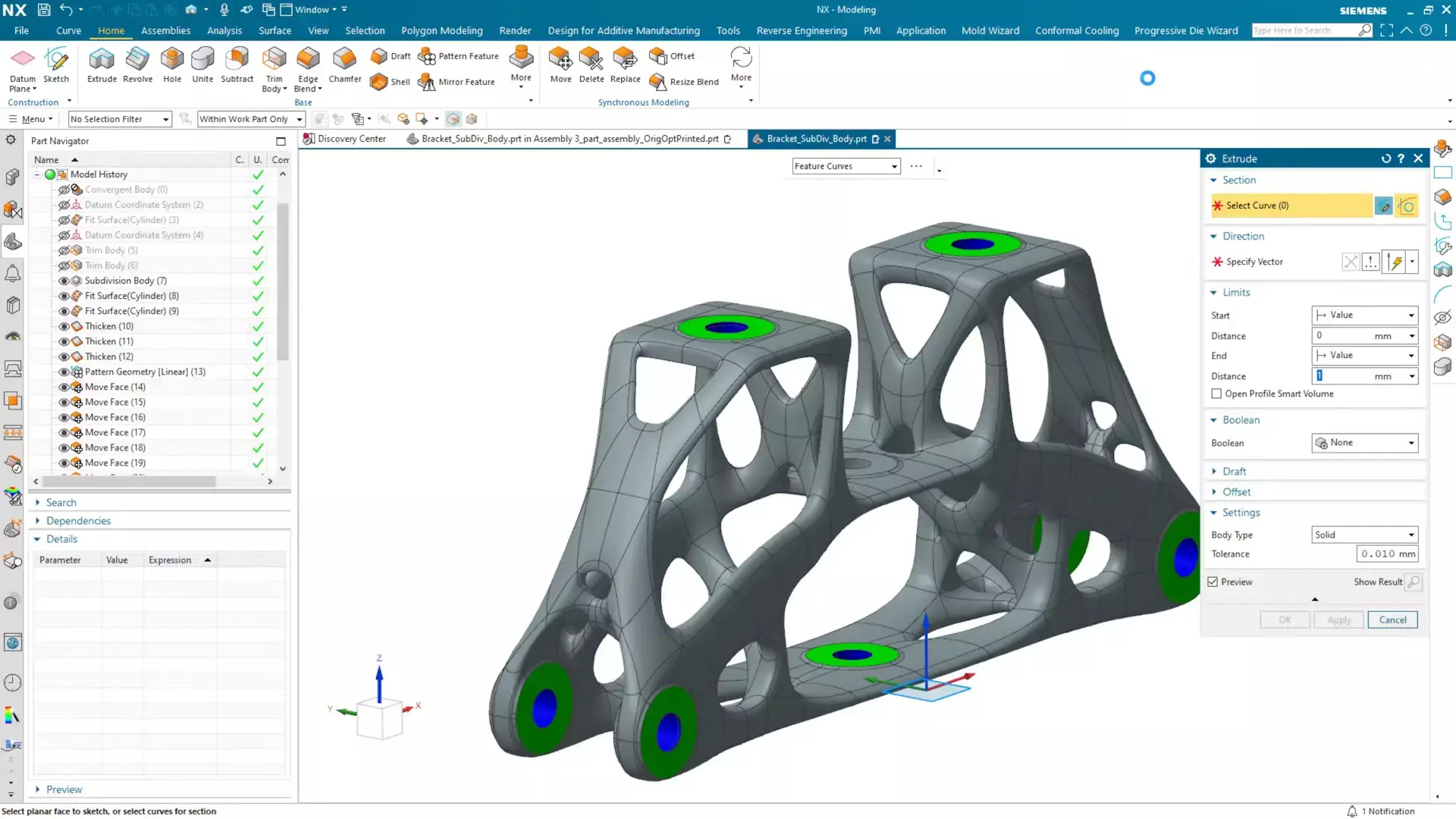
Creating a part or product intended for 3D printing necessitates a unique approach compared to traditional manufacturing methods. Engineers understand that the manufacturing process significantly influences initial design considerations. Therefore, a part’s design must align with the constraints and capitalize on the capabilities of additive manufacturing.
Additive manufacturing offers unparalleled design flexibility compared to techniques like injection molding or CNC machining. Notable features exclusive to additively manufactured parts include:
- Internal structures, such as lattice-filled patterns or intricate winding channels.
- Intricate geometric shapes that were previously challenging or impossible to achieve.
- Capability for multi-material designs, expanding possibilities for functional integration.
- Part consolidation, where multiple components can be combined into a single unit for enhanced efficiency.
- Customization at scale, facilitating tailored solutions for diverse applications.
In various industries, we observe a growing trend of leveraging additive manufacturing for optimized outcomes. For instance, aerospace components like rocket engines and hydraulic parts are designed with AM in mind, consolidating multiple elements into a unified structure for improved performance. Similarly, titanium orthopedic implants and aerospace components benefit from AM’s ability to produce lightweight yet robust products. Additionally, the design of heat exchangers incorporates internal structures achievable only through 3D printing, resulting in enhanced efficiency, compactness, and tailored fits for specific environments.
By embracing the capabilities of additive manufacturing, industries are advancing towards lighter, more efficient, and functionally superior products across diverse applications.
Understanding Design for Additive Manufacturing is essential if you use 3D printing anywhere in your production process. But where should you begin? This guide explains the basics of DfAM and introduces the intermediate and advanced concepts you need to succeed.
With Additive Manufacturing (AM), you can design parts and products that are lighter, higher-performing, and potentially cheaper to produce than their traditionally manufactured counterparts.
AM products can also be mass-customized to fit the physiology or preferences of their end-user, optimized for performance, reduce material wastage, simplify the supply chain, and (almost as a by-product) have an aesthetically-pleasing organic appearance. If you are considering incorporating a 3D printing process at any point during production, then it is essential to have a good understanding of the basic Design for Additive Manufacturing (DfAM) principles.
This article will guide you through the various concepts, skills, design methods, and best practices used in state-of-the-art Design for Additive Manufacturing.


