When you spend several hours performing laboratory tasks, the right seating can affect your comfort, posture, concentration, and efficiency. In a cleanroom, however, you need to consider more than cushioning and adjustability. Your chair should also support contamination control, withstand frequent cleaning, and fit the requirements of your controlled environment. By evaluating cleanroom seating carefully, you can create a workspace that supports both operator comfort and laboratory cleanliness.
Evaluate Cleanroom Compatibility First
Before comparing styles or prices, determine whether the chair is suitable for your cleanroom environment. Conventional office chairs may contain materials, fabrics, seams, or exposed components that can make cleaning more difficult or contribute unwanted particles.
Look for smooth, non-porous surfaces that are easy to wipe and disinfect. Cleanroom-compatible materials should resist commonly used cleaning agents and maintain their condition after repeated sanitation. Avoid unnecessary crevices where dust, liquids, or residues can accumulate.
You should also consider the cleanliness classification of your workspace. The seating design should match your facility’s contamination-control requirements rather than simply looking like a cleanroom product.
For long laboratory sessions, combine contamination-control requirements with ergonomic considerations. A chair that meets cleanliness expectations but causes discomfort after an hour may not be suitable for your daily workflow.
Check Adjustability for Your Workstation
Your working height has a direct effect on posture. If your laboratory bench or workstation is fixed at a particular height, your chair should allow you to position yourself comfortably without raising your shoulders or bending excessively.
Prioritize features such as:
- Adjustable seat height
- Suitable seat depth
- Stable back support
- Appropriate foot support
- Controlled movement when required
- A comfortable seating position for extended tasks
You should be able to keep your feet supported while maintaining a neutral working posture. Your elbows should remain reasonably close to the work surface, and you should not need to lean forward continuously to see samples, instruments, or documentation.
If multiple people use the same workstation, adjustable seating becomes even more valuable because each operator can establish a suitable working position.
Consider Materials, Cleaning, and Durability
Long-term laboratory use can expose seating to disinfectants, moisture, chemicals, and repeated cleaning cycles. Therefore, material selection matters as much as ergonomic design.
Choose surfaces that can be cleaned thoroughly without requiring complicated maintenance. Seamless or carefully constructed upholstery can reduce areas where contamination may collect. The chair should also be durable enough to withstand daily use without becoming difficult to clean.
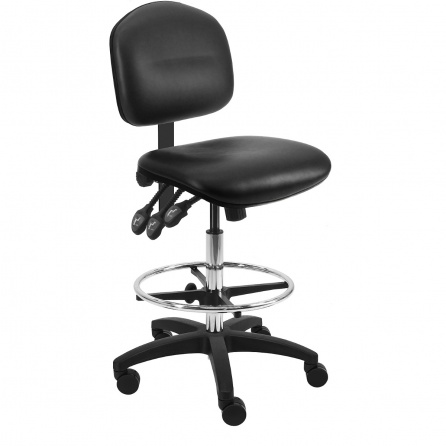
When reviewing ergonomic cleanroom seating for extended laboratory work, examine the construction closely. Consider the seat material, frame, casters, adjustment mechanisms, and other components that may come into contact with cleaning solutions.
Do not overlook the base and wheels. In some environments, movement needs to be controlled to prevent unnecessary disturbance or interference with nearby equipment. Your choice should reflect how the chair will actually be used within the laboratory.
Match the Chair to Your Workflow
The best chair depends on the work you perform. A technician conducting repetitive bench procedures may have different requirements from someone operating equipment or working at a computer.
Think about how often you sit, stand, move, reach, and change positions during a typical session. If your work requires frequent movement, choose a design that allows controlled mobility without compromising stability.
For stationary tasks, a stable chair with appropriate height adjustment may be more practical. If you regularly move between workstations, mobility features may be more useful.
You should also account for available floor space. A chair that works well in a spacious laboratory may be inconvenient around compact equipment or narrow work areas.
Prioritize Comfort Without Ignoring Cleanliness
Comfort should not mean adding features that conflict with contamination control. Thick fabric upholstery, exposed padding, or complicated mechanical components may be unsuitable for certain controlled environments.
Instead, look for a balance between ergonomic support and cleanability. A properly shaped seat can provide support without introducing unnecessary materials or difficult-to-clean surfaces.
If you regularly work for several hours, test the seating position whenever possible. Pay attention to pressure points, back support, seat height, and your ability to change position. Small ergonomic problems can become noticeable when repeated throughout a working day.
You can explore cleanroom seating solutions for comfortable long-duration laboratory work to compare options designed for controlled work environments.
Review Maintenance and Total Value
Price should not be your only selection factor. A lower-cost chair may become expensive if it wears quickly, requires frequent replacement, or becomes difficult to maintain.
Consider the expected service life, cleaning requirements, replacement parts, adjustability, and warranty information. You should also confirm that the chair’s materials are appropriate for the cleaning procedures used in your facility.
When comparing products, create a simple checklist based on your actual requirements. Include cleanroom compatibility, ergonomic adjustment, material durability, mobility, maintenance, and workstation dimensions.
This approach helps you select seating based on long-term performance rather than appearance alone.
Choose Seating That Supports Your Laboratory
Selecting seating for long laboratory sessions requires a practical balance between ergonomics, contamination control, durability, and workflow. You need a chair that allows you to work comfortably while remaining appropriate for the controlled environment.
For a broader selection of laboratory and cleanroom equipment, you can explore Global Lab Supply laboratory and cleanroom equipment solutions. Review your workspace requirements before making a purchase, and choose seating that supports the way you actually work.
If you need help determining which option fits your application, Contact us today for cleanroom seating and laboratory equipment guidance and discuss your requirements with the supplier.
FAQs About Cleanroom Seating
What should you consider when choosing cleanroom seating?
Consider cleanroom compatibility, smooth and cleanable materials, ergonomic adjustment, durability, stability, mobility, and compatibility with your workstation height.
Is ergonomic seating suitable for cleanrooms?
Yes. Ergonomic seating can be suitable for cleanrooms when its materials, construction, and cleanability meet the requirements of the controlled environment.
What materials are suitable for cleanroom chairs?
Materials with smooth, durable, non-porous, and easy-to-clean surfaces are generally preferable. Your facility’s cleaning procedures and contamination-control requirements should guide the final selection.
Why is adjustable height important for laboratory seating?
Adjustable height helps you position your body correctly relative to the laboratory bench or workstation, which can support better posture during extended work sessions.
How do you maintain cleanroom seating?
Follow the manufacturer’s cleaning instructions and your facility’s sanitation procedures. Clean the seat, backrest, frame, base, and other accessible surfaces regularly using approved cleaning agents.