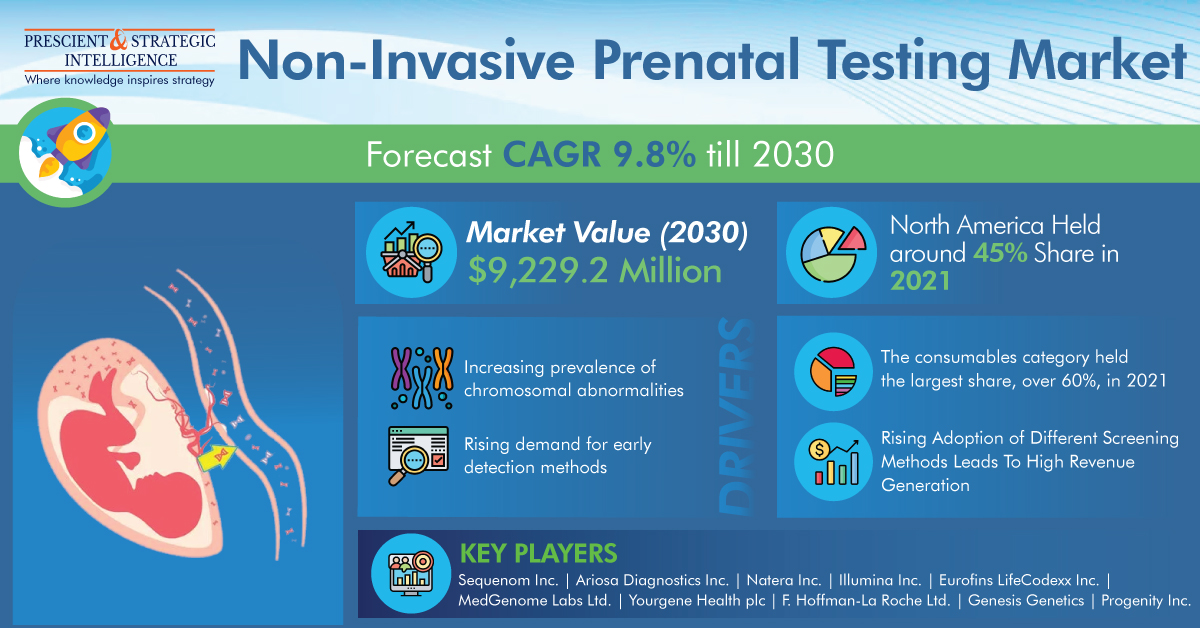
In 2021, the global non-invasive prenatal testing market was worth around $3,987.1 million, which is predicted to touch $9,229.2 million at a 9.8% CAGR from 2021 to 2030. This is due to the growing cases of chromosomal abnormalities and surging requirement for early detection techniques.
Segmentation Analysis
Trisomy holds the largest share, based on application, and it is predicted to grow at the highest CAGR during the forecast period. This is owing to the growing count of females becoming pregnant at a later age, which significantly increases the danger of chromosomal abnormalities.
The consumables category holds the biggest share, of over 60%, owing to the presence of a large number of suppliers of reagents, assay kits, and disposables. The biggest share can also be attributed to the advancements in NIPT tests and a significant number of assay approvals.
Adoption and Awareness of NIPT Are Growing in North America
- North America holds an around 45% share, and it is predicted to maintain its position in the coming years. This is due to the growing acceptance of this approach among the population, high success rates of NIPT, as well as the technological advancements and strong diagnostics infrastructure.
- In addition, the U.S. accounts for the leading position in North America, and it will advance at a rate of 8% in the future. The need for prenatal testing continues to increase due to the rising prevalence of chromosomal disorders in the U.S.
- The APAC non-invasive prenatal testing market is predicted to have considerable growth as a result of the rising need for chromosomal abnormality treatment in developing countries, such as India and China.
Increasing Use of Various Screening Techniques
Cell-free DNA in maternal plasma tests are performed the most, as this technology is highly effective in detecting the likelihood of a faulty gene. As per government sources, among the over 15,000 expecting mothers who have tested positive for genetic malformations in the fetus using NIPT, this approach has been used in almost 80%.
This technology is followed by ultrasound detection, which is often employed as complementary. While cell-free DNA in maternal plasma tests indicate the presence or likelihood of a genetic disorder, a sonograph helps gynecologists and obstetricians actually see its physical manifestation.
The Emergence and Growth of the Non-Invasive Prenatal Testing Market