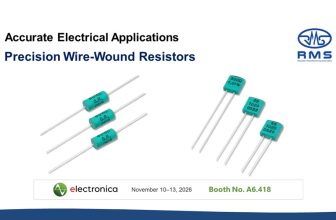
Precision resistors are important components in electrical and electronic systems where accurate resistance, stable performance, and reliable signal control are required. RMS Co., Ltd. offers precision resistors and precision wire-wound resistor solutions designed for applications that demand consistent electrical characteristics and dependable long-term performance.
The 5G10 and GG102 Series provide precision wire-wound resistor options for measurement, instrumentation, control, testing, and other electronic applications where resistance accuracy is an important design consideration.
How Precision Wire-Wound Resistors Work
Wire-wound resistor technology provides controlled resistance by winding resistive wire around an insulating core. The resistance characteristics depend on the resistive element and its construction.
This construction allows high accuracy resistors to provide stable and consistent resistance performance in circuits where resistance accuracy is critical.
In measurement and control circuits, resistance variation can affect voltage, current, signal levels, calibration, and measurement results. Engineers therefore need to consider not only nominal resistance but also accuracy, temperature behavior, power requirements, and long-term stability.
What Makes a Resistor a Precision Resistor?
Precision resistor performance cannot be evaluated using a single specification.
Resistance tolerance indicates the permitted difference between nominal and actual resistance. A tighter tolerance provides a narrower range of initial resistance variation.
Temperature coefficient of resistance (TCR) describes how resistance changes with temperature. Even a resistor with tight initial tolerance can experience resistance variation as its operating temperature changes.
Long-term stability is also relevant in measurement and instrumentation applications because resistance drift over time can affect calibration and measurement consistency.
For this reason, engineers should evaluate tolerance, TCR, operating temperature, power handling, and long-term resistance stability together when selecting a precision resistor.
5G10 Precision Wire-Wound Resistors
The 5G10 Series is designed for precision applications requiring accurate and dependable resistance performance. Its wire-wound construction makes it suitable for electronic equipment where resistance stability and precision are important design considerations.
The series can be considered for precision circuits, measuring instruments, control systems, laboratory equipment, and other applications requiring consistent resistor performance.
Key Engineering Considerations
For a precision wire-wound resistor such as the 5G10, engineers should verify the required resistance range, power rating, tolerance, TCR, and operating temperature against the official product specification before final component selection.
These parameters influence different aspects of resistor performance. Resistance and tolerance determine the nominal operating target and initial accuracy, while TCR and temperature conditions affect how resistance may change during operation.
GG102 Precision Wire-Wound Resistors
The GG102 Series provides another precision wire-wound resistor solution for electrical and electronic applications. It is designed for circuits where accurate resistance and stable operation are important.
Its precision characteristics make the GG102 Series relevant to instrumentation, measurement systems, control equipment, and other applications requiring dependable resistance performance.
Key Engineering Considerations
When evaluating the GG102, engineers should consider the same combination of electrical and environmental parameters rather than selecting the resistor based solely on nominal resistance.
The required resistance value, tolerance, TCR, rated power, operating temperature, mounting conditions, and expected long-term stability should be considered according to the requirements of the circuit.
* Technical note: The numerical fields for 5G10 and GG102 in the current source material appear internally inconsistent—for example, values expressed in watts are associated with “Tolerance.” For that reason, this final draft does not reinterpret those values as verified specifications. The original RMS product datasheet should be used to confirm the numerical specifications before publication.
Why Tolerance and TCR Matter in Precision Circuits
Tolerance and TCR describe two different sources of resistance variation.
Tolerance defines the permitted difference between nominal and actual resistance under specified conditions. TCR describes how resistance changes as temperature changes.
For measurement, instrumentation, and control circuits, both can contribute to total resistance error. A resistor with a tight initial tolerance may still experience resistance change as component temperature varies during operation.
Engineers should therefore evaluate expected ambient temperature, component self-heating, required measurement accuracy, and calibration requirements together with tolerance and TCR.
Where long-term measurement consistency is important, resistance stability over time should also be considered.
Choosing a Precision Wire-Wound Resistor
Selecting an appropriate precision resistor requires matching the component to the complete electrical and operating environment.
Engineers should consider:
- Required resistance value
- Resistance tolerance
- TCR
- Rated power
- Operating temperature
- Long-term resistance stability
- Mounting requirements
- Environmental conditions
- Required measurement or control accuracy
The relative importance of these parameters depends on the application. Measurement and instrumentation systems may place greater emphasis on tolerance, TCR, and long-term stability, while other applications may require a different balance between precision and power handling.
RMS Precision Resistor Solutions
The RMS precision resistor portfolio provides multiple resistor technologies and configurations for applications requiring accurate and stable resistance characteristics.
By evaluating construction, resistance, tolerance, power, temperature characteristics, and system requirements together, engineers can identify a resistor technology appropriate for the intended measurement, control, testing, or industrial application.
Meet RMS at electronica 2026 in Munich
RMS Co., Ltd. will participate in electronica 2026, taking place from November 10 to 13, 2026, at Messe München in Munich, Germany.
Passive components are among the exhibition categories, making the event relevant to RMS and its resistor technologies. Visitors can meet RMS at Hall A6, Booth 418 to learn more about its precision wire-wound resistors and other resistor solutions for measurement, control, industrial, and electronic applications.
The exhibition also provides an opportunity for engineers and buyers to discuss resistance accuracy, power, temperature characteristics, and specific application requirements directly with RMS.
Event Information
– Event: electronica 2026
– Date: November 10–13, 2026
– Venue: Messe München, Munich, Germany
– Exhibition Area: Passive Components
– RMS Booth: Hall A6, Booth 418
👉 electronica 2026 Official Website
Looking for precision resistor solutions or planning to visit electronica 2026?
Meet RMS at Hall A6, Booth 418 in Munich or explore RMS thin film and high voltage film resistor solutions online.
Click here to learn more about RMS products.
View more: Precision Wire-Wound Resistors for Accurate Electrical Applications